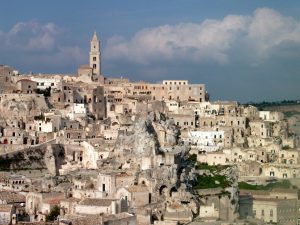
Fatti soprannaturali sul film PASSIONE DI CRISTO girato a Matera

Mel Gibson avvertì l’attore Jim Caviezel, che avrebbe dovuto interpretare il personaggio di Cristo, che sarebbe stato molto difficile e che, se avesse accettato, molto probabilmente sarebbe stato emarginato da Hollywood.

Caviezel chiese un giorno per pensarci e poi la sua risposta a Mel (che stava finanziando e dirigendo il film), fu: “Penso che dobbiamo farlo, anche se è difficile. Eppoi, c’è un’altra cosa: le mie iniziali sono J.C. e ho 33 anni. Non me ne ero reso conto fino a ora”. Mel gli rispose: “Mi stai spaventando, lo sai?”. Era il 2002 e il film uscì, fra le polemiche, nel 2004.

Durante le riprese, Jim Caviezel, che interpretava il ruolo di Gesù, perse 20 chili, venne colpito da un fulmine, e fu accidentalmente colpito per due volte durante la scena della flagellazione, lasciandogli una profonda cicatrice di 10 cm sulla schiena; si slogò la spalla, quando la croce cadde nel buco con lui appeso sopra. Soffrì di polmonite e di ipotermia, per essere rimasto sulla croce, per molte ore e quasi nudo, con il solo perizoma a coprirlo. La sola scena della crocifissione ha richiesto 5 settimane di lavoro, dei 2 mesi totali di riprese.

Il suo corpo era così stressato ed esausto per aver interpretato quel ruolo che dovette sottoporsi a due interventi chirurgici a cuore aperto, subito dopo le riprese.

Jim ha spiegato: “Non volevo che la gente vedesse me. Volevo che vedessero Gesù. Le conversioni arriveranno”. La sua fu quasi una predizione da chiaroveggente, infatti, accaddero poi molte cose sorprendenti.

Pedro Sarubbi, che interpretava Barabba, sentì che non era Caviezel a guardarlo, ma Gesù Cristo stesso; mentre interpretava quel ruolo, disse di Caviezel: “I suoi occhi non avevano odio o risentimento verso di me, ma solo misericordia e amore”.

Luca Lionello, l’artista che ha interpretato Giuda, era un ateo dichiarato prima dell’inizio delle riprese. Alla fine si è convertito e ha battezzato i suoi figli. Uno dei principali tecnici che hanno lavorato al film era un musulmano ma si convertì al cristianesimo.

Alcuni produttori hanno detto di aver visto degli attori vestiti di bianco che non hanno poi riconosciuto durante una delle sessioni di riprese, e quando hanno rivisto le registrazioni, si sono resi conto di non poterli vedere in quel filmato.

La Passione di Cristo è il film religioso statunitense che ha incassato di più, nonché il film con rating più alto di tutti i tempi, con 370,8 milioni di dollari! A livello mondiale, ha incassato 611 milioni di dollari. Ma, soprattutto, ha raggiunto 100 milioni di persone in tutto il mondo.

Mel Gibson ha pagato 30 milioni di dollari di tasca sua per la produzione del film, perché nessuno studio avrebbe accettato il progetto. Oggi, Jim Caviezel proclama semplicemente e coraggiosamente la sua fede in Cristo e il miracolo che è stato per lui rappresentare Cristo come attore e un maggiore credente di Cristo grazie a questa esperienza.

La magia della città di Matera ha completato in maniera perfetta questo quadro mistico e artistico, nessuna altra città del mondo, inclusa la moderna Gerusalemme, avrebbe mai potuto sostituirla.


Why they offered Coca-Cola to Jesus on the cross

Jesus on the cross received a sponge with some water and vinegar, I remember this episode of the Passion, retold countless times in the church. It struck to me as an additional cruelty inflicted on our Saviour and it was as such explained by the priest. This vivid episode appears in all four Gospels in slightly different forms.

Matt.27 [34]
They gave him vinegar to drink mingled with gall: and when he had tasted thereof, he would not drink.

Matt. 27 [48]
And straightway one of them ran, and took a spunge, and filled it with vinegar, and put it on a reed, and gave him to drink.

Luke.23 [36]
And the soldiers also mocked him, coming to him, and offering him vinegar

Mark.15 [36]
And one ran and filled a spunge full of vinegar, and put it on a reed, and gave him to drink, saying, Let alone; let us see whether Elias will come to take him down.

John.19 [29]
Now there was set a vessel full of vinegar: and they filled a spunge with vinegar, and put it upon hyssop, and put it to his mouth.

John. 19 [30]
Jesus therefore had received the vinegar, he said, It is finished: and he bowed his head, and gave up the ghost.

According to Matthew the vinegar was first offered to him mixed with gall but he refused it. Perhaps it is true, as it is explained, that the first vinegar laced with gall (animal bile) was offered as a sort of anaesthetic. According to old traditions, respected women of Jerusalem provided a narcotic drink to those condemned to death in order to decrease their sensitivity to the excruciating pain. It may well be but I believe that it was just a pot of liquid which was there as a drink for the soldiers and the executioners. Gall, that is bile secretion, is used also in Chinese traditional medicine, taken from various animals and even humans. It is very bitter but it possess anti-oxidant and astringent properties, it is also a sedative and a powerful defence against pathogenic attacks. Not only that: it is a strong natural hypnotic, giving you a kick like a glass of whisky.

A sour drink with vinegar is mentioned in the Bible as a refreshing drink (Numbers 6:13; Ruth 2:14), and in Greek and Roman literature as well. It was a common beverage appreciated by labourers and soldiers because it relieved thirst more effectively than common water. Therefore, the sponge with the vinegar offered to Jesus was not a hostile gesture or a jest, but it was simply the standard drink of the Roman soldiers and of the common people.

Even if the soldiers on the Golgotha were almost certainly not career Roman soldiers, but local auxiliary troops, perhaps from Greece or Syria, they were still using such drink instead of water. Some of those soldiers tried to help him in his sufferings by offering their drink, to alleviate his pain and ease his way out of this unjust world. That day was most probably Friday, April, 3rd AD 33 on the Julian calendar, or April 1st, 33 on the Gregorian calendar. Why can we be sure of the date? Because of a partial moon’s eclipse in Jerusalem on that night at 6:20 PM, as mentioned by Peter (Acts 2:20).
Girolamo Cardano (1501-1577?) mentioned this drink as one of the possible causes of Roman prowess: because of it they were better protected from infections. Cardano, an historian and a physician, was the first in his Neronis Encomium to make a connection between Roman drinking habits and their military might.

This type of drink was called Posca and was vinegar mixed with water and spices. For centuries was their standard drink and if honey was added, it was heated to dissolve it, making it even more safe and in addition to that,  because of the acetic acid it contained, it possessed mild disinfectant properties.

Posca could be compared to Coca-Cola and it was tasting, at its best, like the famous American drink: slightly acidic and bitter if mixed with gall or with special herbs, plus honey.