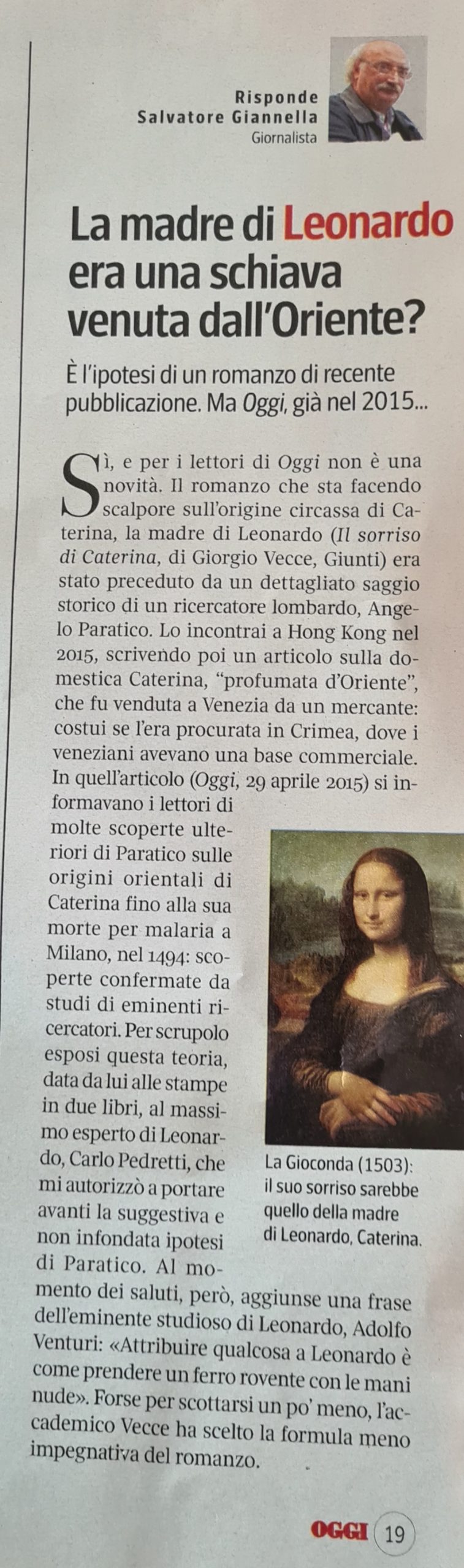

Carlo Vecce ha scoperto quello che aveva descritto Angelo Paratico nel suo libro, uscito nel 2015

Leonardo Da Vinci: lo storico Carlo Vecce annuncia la scoperta sulla madre del genio, era una schiava

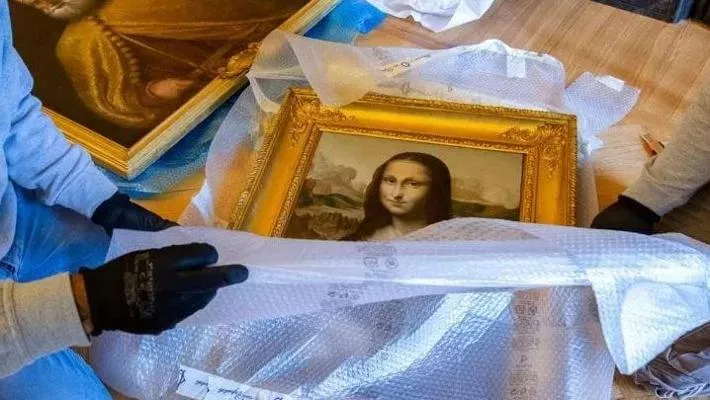
Caterina era il nome della schiava, l’atto di liberazione della donna, sarebbe stato rogato dal padre notaio Piero da Vinci e datato 2 novembre 1452

Si chiamava Caterina la madre di Leonardo da Vinci, ce lo rivela un documento scoperto nell’ Archivio di Stato di Firenze  che rivela anche che la donna fosse stata una principessa dei Circassi, figlia del principe Yakob, che governò uno dei regni sugli altopiani delle montagne  settentrionali del Caucaso: dopo essere stata rapita, probabilmente  dai tartari, fu fatta schiava e rivenduta ai veneziani. Il professore Carlo Vecce, filologo e storico del  Rinascimento, docente all’Università di Napoli “L’Orientale” rivela i dettagli sulla nuova identità della mamma del genio del  Rinascimento, che quindi sarebbe stato italiano solo per metà. L’annuncio della scoperta, che potrebbe mettere una parola definitiva  sull’identità della donna che partorì Leonardo, è stato dato questa mattina a Firenze, nella sede di Giunti Editore.

Il nostro collaboratore, Angelo Paratico, aveva pubblicato a Hong Kong, in lingua inglese un testo basato su questa teoria e una grossa stazione televisiva giapponese prese in considerazione l’ipotesi di girarci un docufilm. Poi il progetto fu archiviato.

Negli archivi di Firenze si trovano vari documenti notarili vergati da Piero Da Vinci, il padre notaio di Leonardo e uno di questi appare nel libro di Paratico, anzi pare essere proprio quello citato dal Paratico, ma non avendo visto il documento originale nella sua interezzza, non vide quella citazione “caucasica”.

Se davvero è emerso un documento come quello descritto dal Prof.Vecce nel suo romanzo, ovvero la malleva  di Caterina “filia Jacobi eius schiava seu serva de partibus Circassie”, in un atto datato 2 novembre 1452, ossia circa sei mesi dopo la nascita di Leonardo, su istanza  della proprietaria della schiava, una certa Ginevra d’Antonio Redditi, moglie di Donato di Filippo di Salvestro Nati

Tale Caterina, madre di Leonardo, spirò fra le braccia del figlio a Milano. Un documento ritrovato una ventina d’anni or sono negli archivi di Milano, mostra il suo atto di morte, che coincide con la notazione delle spese indicate da Leonardo nel Codice Forster circa il “sotterramento di Caterina”.

La prima edizione del libro di Paratico fu pubblicata in inglese, a Hong Kong, nel 2015 con grande rilevanza mediatica, soprattutto a causa del fatto che i francesi s’infuriarono perché la Gioconda (come intuito da Sigmund Freud) sarebbe una immagine onirica di Caterina, madre di Leonardo.

La seconda edizione in italiano è stata pubblicata dalla Gingko Edizioni, a Verona, nel 2018.


Ambrogio Bianchi

Leonardo’s mechanical lion

Leonardo had built an automaton (a robot) in the shape of a lion, which was capable of walking, then after sitting on his hind legs, his chest opened and some fleur-de-lis (lily flowers) were taken out and offered to the person standing in front of it. All people who had seen it were amazed. Vasari described it in his Life of Leonardo and Gian Paolo Lomazzo, although he never saw it, quotes the words of Francesco Melzi, Leonardo‘s disciple. (1)
The construction drawings are lost and so we do not know how it was built but what is clear is that for functioning he had to have some cogs, pulleys and an escapement system inside. (2)

It appeared first on 12 July 1515 at the entry in the city of Lyons of the new King of France, Francis I. Possibly Leonardo had built it in Florence, were real lions were kept behind Piazza della Signoria (3) and then took it to France.
It appeared again in Amboise, almost five centuries ago, on 30 September 1517 according to Lorenzo Ariosto. Again, the following year it was shown at Amboise at the celebrations for the marriage of Lorenzo II de Medici with a French Princess.

In 2006 Jill Burke published a newly found document in the Oxford Art Journal with the description of another Lion created by Leonardo in Milan for the entry into the city made by King Louis XII of France in 1500, it was simpler: he could stand up and opening the chest where the lilies were. That was possibly his first prototype. (4)

Nothing more is known about this robot created by Leonardo. But a mechanical Lion did appear in France in 1600 according to a little-known booklet written by Michelangelo Buonarroti Junior. The author says that it was ‘similar to the one that Leonardo da Vinci carried in the city of Lyon for the arrival of King Francis’ but since the working system and functioning was the same, it is possible that it was the same machine. (5)

Leonardo’s biographers seem to have overlooked a previous appearance of the famous lion, again in the city of Lyons, and on a royal occasion: the entry into the city by King Henry II on 23 September 1548 with his mature lover, Diane de Poitier at his side. His wife, Queen Catherine de’ Medici, made her entry the following day. Here is what Leonie Frieda (6) says:

Upon entering the city, which had been transformed into resemble Ancient Rome, the King was greeted by 160 men dressed as Roman legionnaires. The party then came into an artificial forest from which emerged a group of nymphs led by a young beauty carrying a silver bow and quiver, representing the goddess of the hunt. The lovely girl approached the King leading a mechanical lion on a chain of silver and black silk, symbolizing the city of Lyons. Saluting the King in verse on behalf of the city, she symbolically offered him its keys.

Catherine wanted to impress the townsfolk to make clear that she was the real Queen, not Diane de Poitier and she entered on a litter, covered from head to shoes with a dress full of diamonds. Again, the authorities of Lyons had the mechanical lion ready for her to see but that day it took out of its chest a heart decorated with the Medici’s coat of arms. (7)


Notes:

1. G.P Lomazzo Trattato dell’Arte della Pittura, Scultura et Architettura […] diviso in sette libri Pontio, Milan, 1584.
2.Luca Garai in: The Automatic Lion in Leonardo Da Vinci & France CB Publishers under Carlo Pedretti’s supervision, Amboise 2009.
3. In a note in the Codex Atlanticus datable to 1513 (f. 249 r.a.) the words ‘room of the lions of Florence’ appear.
4.Jill Burke Meaning and Crisis in the early Seventeen Century: interpreting Leonardo’s Lion Oxford Art Journal XXIX March 2006.
5. Michelangelo Buonarroti il Giovane Descritione delle felicissime nozze della Cristianissima Maesta’ di Madama Maria Medici Regina di Francia e di Navarra, Florence, 1600, p.10.
6. Leonie Frieda Catherine de Medici. Renaissance Queen of France Harper Collins, New York, 2003. Pag. 86
7.Leonie Frieda Catherine de Medici. Renaissance Queen of France Harper Collins, New York, 2003. Pag. 87

Dal un deposito di Montecitorio emerge una Gioconda. Ma non è una copia di Leonardo.

La copia della Monna Lisa appare sul sito parlamentare “ArteCamera”, accompagnata da una breve scheda redatta dagli studiosi della quadreria statale di appartenenza che si sono guardati dal parlare di «bottega di Leonardo» o di «mano del maestro», definendola «una copia che aspira a replicare diligentemente il suo modello», la Gioconda del Louvre. La prima “sorella gemella” della Gioconda, una copia (quasi) perfetta del quadro di Leonardo Da Vinci, la tela più famosa al mondo ospitata al Museo del Louvre di Parigi, era stata trovata a Montecitorio a inizio dicembre 2022, durante alcuni lavori nel palazzo del potere italiano per eccezione. I lavori di restauro sulla tela avevano poi rivelato che dietro ci potrebbe essere stata la «mano» di Leonardo Da Vinci.

A restaurare il dipinto è stata Cinzia Pasquali, e sulle restauratrici che confondono fasi per vere ne son piene le cronache, pur essendo tra le restauratrici più famose al mondo. Romana ed esperta di Leonardo da Vinci, vive da oltre 25 anni a Parigi e lavora al Louvre. È l’autrice di quello che è stato definito il “restauro del secolo”: la “Sant’Anna con la Vergine e il Bambino”, proprio di Da Vinci. Quando si è accorta delle analogie con la “vera” Gioconda, ha chiamato Vincent Delieuvin, capo curatore dei dipinti per il Louvre, che ha preso il primo volo per Roma.

L’opera è nota anche come Gioconda Torlonia perché in passato è stata di proprietà della nobile famiglia romana, ed è una delle decine di copie esistenti della celeberrima Monna Lisa di Leonardo da Vinci. Non è neanche tra quelle di miglior qualità menzionando anche l’opera che adesso si vuole far passare come appena scoperta). Si tratta di un dipinto dalla storia ben nota: documentata nel 1814 negli inventari dei Torlonia come “copia della Gioconda di Leonardo da Vinci” (fu attribuita a Bernardino Luini da Giuseppe Antonio Guattani, ma anche quest’attribuzione poi decadde in quanto troppo debole), entrò a fa parte della Galleria Nazionale d’Arte Antica di Palazzo Barberini nel 1892, dopodiché, nel gennaio del 1927, fu concessa in deposito alla Camera dei Deputati, e da allora si trova a Montecitorio..

Lapidario anche Vittorio Sgarbi: “Macché seconda Gioconda! È solo una modesta tela! Roba da arredamento confusa da menti ottenebrate”, ha detto il vulcanico storico dell’arte ferrarese. “Una modesta tela esposta in un palazzo pubblico, nell’Ufficio del Questore di Montecitorio, è stata fatta passare come una seconda Gioconda di Leonardo, che, per inciso, ha fatto fatica (ci ha messo 5 anni) a dipingerne una. L’eccitazione di menti ottenebrate ha evocato con grande suggestione magazzini, depositi, polvere, evitando l’unica parola pertinente: arredamento! E cioè quello che solitamente, provenendo dai depositi di un museo viene chiesto, a partire dalla Camera e dal Senato, e poi da ambasciate e prefetture, per arredare sale aperte al pubblico, come da anni è Montecitorio.

Leonardo’s Salvator Mundi. Is it a genuine prank?

The painting on the left is going to be sold at Christie’s New York on 15 November. It underwent  a very strong cleaning, to remove all the additions made throughout the centuries  and, after restoration,  it appears to be a genuine work by Leonardo Da Vinci.  This is proven also by several others clues: the pentimenti seen using X-rays, the brush strokes and the preparatory sketches found in his notebooks. This picture was possibly painted in Milan during his second stay and, perhaps for Charles D’Amboise, the French governor or even for his master, King Louis XII. Notwithstanding its grace, there is curious detail in this masterpiece which has been overlooked by historians and art critics: the cross on the orb is missing!

The representation of Christ’s as Salvator Mundi (Latin for saviour of the world) is not rare, starting with the end of the XV century: with Carlo Crivelli (1472); Cima da Conegliano (1497) and then several Northern painters, such as Jan van Eyck, Hans Memling. Afterward also Leonardo Da Vinci, Durer, Antonello da Messina, Previtali, Titian and several others tried their hand at it, producing slightly different versions.

With such representation, Christ is always shown with the right hand raised in a blessing and his left hand is holding a crystal orb, surmounted by a cross, the ensemble is known as globus cruciger. Only in Leonardo Da Vinci’s representation of the Salvator Mundi there is no cross over the orb, which seems rather odd. Given the fact that the orb put in the hand of Christ, not only represented the Earth but also the coming of the Apocalypse, it goes without saying that it is charged with deep eschatological meanings.


The use of crystal balls seems to have begun in Medieval times and some were found in the royal burials of the Merovingian.
The first documented use of a crystal ball to divine the future appears with the British mathematician and occultist, John Dee – an adviser of Queen Elisabeth I – who had claimed to have received it from an angel, on 21 November 1582 and then used it with fellow occultist Edward Kelley. Kept with its mounting at the British Museum in London, it is made of beryl with a diameter of 6 cm.
Though its path is murky, the crystal ball was used throughout the medieval period by Anglo–Saxons as both a mean of magic and a flashy fashion accessory. It was suggested that Merlin chose to carry one, also made of beryl, in case King Arthur needed a quick prediction.


Since the cross over the ball is missing, is it a way for Leonardo to say that Christ was a fake savior and a wizard, just capable of playing tricks?It is well documented that Leonardo was an atheist throughout the course of his life, even if he did appear to have repented on his death bed, in Amboise, while giving up his soul in the arms of King Francis I of France.

It has been said that the orb do not show any distortion of light, but this may be due to the fact that Leonardo did not care much about it (perhaps made by one of his pupils) or that it is not glass by beryl. In a close up – visible in the film linked below – impurities are highly visible inside the base of the ball.

http://hk.apple.nextmedia.com/realtime/supplement/20171020/57352532


Another fake Leonardo da Vinci? Possibly not…

A small tile bearing the image of the Archangel Gabriel is, according to some art experts in Rome, the oldest surviving work made by Leonardo da Vinci. He did it when he was 17 and it is the only one bearing his signature. Except for a sketch with a view of the Valdinievole on paper, kept at the Uffizi Museum in Florence and drawn when he was 20, there is nothing else signed.

Prof. Ernesto Solari thinks that it a self-portrait of Leonardo and, we have to admit that, its likeliness with the David by Verrocchio are indeed impressive. Leonardo shows here a strong oriental look, with thin eyebrows, low cheeks. These are traits which not necessarily derives from his mother being an Oriental slave – as we have argued – but that was a typical mark of the old Sienese school of painting, which was often used for the representation of  sacred images. This is clearly visible in Giotto and Simone Martini

Solari’s claim was dismissed out of hand by Leonardo’s expert Martin Kemp, who told to the Guardian newspaper: “The chance of its being by Leonardo is less than zero. The silly season for Leonardo never closes.” But Kempt, like the late Carlo Pedretti, is very strong on documents but has little eyes for art. Both of them did several mistakes authenticating works which were then proven false.

The tile was presented encased in a glass at a press conference in Rome by Prof Ernesto Solari, who has written extensively on the Renaissance genius, there was also Ivana Bonfantin, a handwriting expert, who is sure that the small handwriting scratched under the glaze were drawn by Leonardo’s heavenly hand.

There are signatures et inscriptions all over it including a sequence of numbers and Leonardo’s signature back to front in his mirror-writing with a coded message translated as: “I, Leonardo da Vinci, born in 1452, represented myself as the Archangel Gabriel in 1471.”

According to Prof. Solari extensive scientific dating tests, including thermoluminescence (TL), bear out the 15th century date of the tile, which is owned by an aristocratic family in Ravello.

He further adds that the tile was fired in the pottery kiln of Leonardo’s paternal grandparents. This we think unlikely considering that they could not fire pieces of such beauty, but only very basic ones.

Should we conclude that it is a XIX copy? I am afraid we cannot do it. How to explain the positive TL test? Since it shows a firing around the date indicated, then, it should really be a Leonardo da Vinci work. Being a glazed tile it is not possible to use an old tile, then glaze it and have it refired, otherwise the TL test will not respond.

Our conclusioni is that if the TL test is really positive then it can only be a Leonardo Da Vinci.


Morto Carlo Pedretti, uno dei massimi esperti di Leonardo Da Vinci

Il 5 gennaio 2018 nella sua casa di Lamporecchio, in provincia di Pistoia, è morto Carlo Pedretti, considerato in tutto il mondo uno dei massimi esperti su Leonardo Da Vinci, al quale ha dedicato la propria esistenza. Avrebbe compiuto 90 anni proprio il 6 gennaio. Pedretti era originario di Bologna e dall’età di 13 anni fu in grado di scrivere a lettere rovesciate, usando la mano sinistra, a imitazione del grande genio toscano. A 16 anni pubblicò il suo primo articolo dedicato a Leonardo e nel 1944, all’età di 23 anni, veniva giudicato un grande esperto.  Non l’ho mai incontrato di persona, ma ho comunicato con lui solo via email, grazie all’amico scrittore Salvatore Giannella, al quale era molto legato.

Lo storico dell’arte inglese, Kenneth Clark, con il quale Pedretti curò l’edizione del fondo di scritti e disegni conservati a Windsor, di proprietà della corona britannica, scrisse di lui: “Pedretti è senza ombra di dubbio il più grande esperto di Leonardo dei nostri tempi”.
Carlo Pedretti fu nominato professore emerito di Storia dell’Arte in studi leonardiani alla University of California, Los Angeles e anche supervisore del fondo Armand Hammer (allora detentore del Codice Hammer, ora Codice Bill Gates). Fu anche un prolifico autore di articoli e di più di 50 libri pubblicati in varie lingue e ha ricevuto svariati riconoscimenti, medaglie, lauree honoris causa, in Italia e all’estero. La lista è troppo lunga per essere riportata qui.

Come ebbe a dire Adolfo Venturi, negli anni ’30: “Autenticare un Leonardo da Vinci è come prendere in mano un ferro rovente” e, come molti altri esperti, pure Pedretti aveva alcune profonde piaghe sulle mani, anche perché quando gli veniva chiesto d’autenticare un dipinto o un disegno di Leonardo si muoveva sempre con baldanzoso entusiasmo ed eccessiva generosità , spesso usando il proprio istinto, invece che la ragione. Quando invece si muoveva fra i documenti antichi era quasi infallibile e possiamo dire che molte delle intuizioni riguardanti Leonardo, oggi comunemente accettate, originano proprio da lui. Il modo stesso in cui vediamo questo grande artista del Rinascimento è stato fortemente influenzato dai suoi studi e dalle sue ricerche.
“La morte di ogni vecchio è come una biblioteca che brucia” dice un vecchio proverbio, ma nel caso di Pedretti questa immaginaria biblioteca è enorme nella sua estensione. Unica nostra consolazione è il pensare che una delle prime persone che ha incontrato quando  è morto – alla termine del cono di luce – è stato proprio Leonardo Da Vinci, che gli avrà svelato gli ultimi suoi segreti.

Walter Isaacson’s Leonardo da Vinci. The Biography.

Walter Isaacson is the CEO of the Aspen Institute. He has been the chairman of the CNN and managing editor of Time Magazine. Furthermore, he has written quite a number of large books, including a biography of Steve Jobs, Einstein, Benjamin Franklin and Kissinger. Mind you, we are dealing here with a man of great importance!

His latest book is a biography of Leonardo da Vinci, aptly titled “The Biography” as to say that is the definitive one? Or the latest one? OK, never mind. I bought it because when dealing with Leonardo’s Salvator Mundi recently sold at Christie’s at a record price, Isaacson had created waves around the world somewhat describing the crystal orb in the hand of the Christ-like figure represented there as being “not-leonardian” since there were no distortions created by the light passing through the perfectly painted ball.  It was a timely observation, which put this book into the spotlight in all magazines and newspapers, at the right time.  Out of curiosity, I ordered his book, which arrived two days ago. On dealing with Caterina, Leonardo’s mother, the author mentioned, in a note, my book – he even seems to have read it or at least having flipped through it – and because of this I am grateful.

Isaacson mentions the finding, published recently by Martin Kemp and Giuseppe Pallanti, about the theory of Caterina being an orphaned girl of Vinci, a theory already discarded in the 70s by Renzo Cianchi. It is unsupported by documents, as historian Elisabetta Ulivi has demonstrated during a presentation she gave in Florence last week (https://beyondthirtynine.com/caterina-di-cambio-was-she-the-mysterious-mother-of-leonardo-da-vinci-elisabetta-ulivis-latest-discovery/).

After going through it I found several wrong details and fantasy creations, which one would expect by a busy man like Isaacson. An example. There is a picture of the town of Vinci, facing the first chapter, in Tuscany, showing the Church of Santa Croce, where the author says Leonardo was baptized. Well it may have been but there is no record of it. Then, he ignores the fact that his mother and stepfather lived near the San Pantaleo Church, about two kilometers from the center of Vinci, which now lays in ruins.

I thought: just wrong beginning, but on the facing page there is Chapter I about Leonardo’s childhood in Vinci and Isaacson says that: “Leonardo da Vinci is sometimes incorrectly called ‘da Vinci.’ as if that were his last name rather than a descriptor meaning ‘from Vinci.” That’s wrong. The Da Vinci’s family went back to the XIII century, if he would have seen the light in London, would we be dealing today with Leonardo da Londra?

Finally, getting over small imprecisions, I must admit that this is a well written and well researched book, containing all the recent findings about Leonardo, all included and discussed. It is worth buying and reading it.


Il Salvator Mundi di Leonardo da Vinci deve rientrare in Italia

La scorsa settimana ho potuto ammirare un Leonardo Da Vinci originale a Hong Kong. Il quadro è noto come “Salvator Mundi” ed è rimasto esposto per tre giorni negli uffici della Christie’s.

I due responsabili della casa d’aste, Loïc Gouzer e François de Poortere, si dicono certi che, essendo l’unico quadro di Leonardo ancora in mano a privati, spunterà un prezzo superiore ai 100 milioni di dollari previsti. Sono stati tanto gentili da consentirmi d’osservare da pochi millimetri di distanza questo straordinaria opera, dipinta con colori a olio su una tavola di legno di noce (64.5 x 44.7 cm). L’anno dovrebbe essere il 1502, secondo Christie’s, ovvero mentre si trovava a Firenze.

Read More